Home / Resources / Tutorial / Light & Materials - Part I
 

Search


Web
jawoollam.com

Events


Ellipsometry measures the interaction between light and material.
 
Light and Polarization

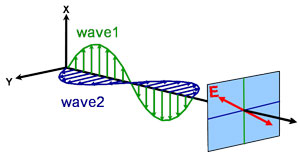
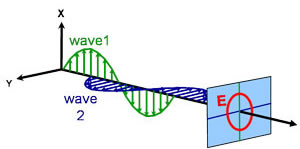
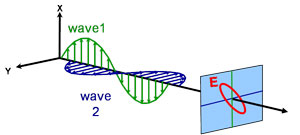
Light can be described as an electromagnetic wave traveling through space. For purposes of ellipsometry, it is adequate to discuss the waves's electric field behavior in space and time, also known as polarization. The electric field of a wave is always orthogonal to the propagation direction. Therefore, a wave traveling along the z-direction can be described by its x- and y- components. When the light has completely random orientation and phase, it is considered unpolarized. For ellipsometry, however, we are interested in the kind of electric field that follows a specific path and traces out a distinct shape at any point. This is known as polarized light. When two orthogonal light waves are in-phase, the resulting light will be linearly polarized (Figure 1a). The relative amplitudes determine the resulting orientation. If the orthogonal waves are 90° out-of-phase and equal in amplitude, the resultant light is circularly polarized (Figure 1b). The most common polarization is “elliptical”, one that combines orthogonal waves of arbitrary amplitude and phase (Figure 1c). This is where ellipsometry gets its name.

(a)
(b)

(c)

Materials
Two values are used to describe the optical properties which determine how light interacts with a material. They are generally represented as a complex number. The complex refractive index () consists of the index (n) and extinction coefficient (k):
[1]
Alternatively, the optical properties can be represented as the complex dielectric function:
[2]
with the following relation between conventions:
[3]
The index describes the phase velocity of light as it travels in a material compared to the speed of light in vacuum, c:
[4]
Light slows as it enters a material with higher index. Because the frequency of light waves remains constant, the wavelength will shorten. The extinction coefficient describes the loss of wave energy to the material. It is related to the absorption coefficient, <alpha>, as:
[5]
Light loses intensity in an absorbing material according to Beer’s Law:
[6]
Thus, the extinction coefficient relates how quickly light vanishes in a material. These concepts are demonstrated in Figure 2 where a light wave travels through two different materials of varying properties before returning to the ambient. 


Figure 2 Wave travels from air into absorbing Film 1 and then transparent Film 2. The phase velocity and wavelength change in each material depending on index of refraction (Film 1: n=4, Film 2: n=2).


The optical constants for TiO2 from the ultraviolet (UV) to the infrared (IR), as shown in Figure 3. The optical constants are determined by wavelength with absorption (k>0) occurring in both UV and IR due to different mechanisms that take energy from the light wave. IR absorption is commonly caused by molecular vibration, phonon vibration, or free-carriers.  UV absorption is generally due to electronic transitions, where light provides energy to excite an electron to an elevated state. A closer look at the optical constants in Figure 3 shows that real and imaginary optical constants are not independent.  Their shapes are mathematically coupled through Kramers-Kronig consistency.


Figure 3 Complex dielectric function for TiO2 film covering wavelengths from the infared (small eV) to the ultraviolet (high eV).


  NEXT
 

Tutorial Introduction

Light & Materials - Part I

Light & Materials - Part II

Ellipsometry Measurements

Data Analysis

Film Thickness

Optical Constants

Conclusion


Home | Products & Services | Sales & Support | Resources | About Us | Contact Us