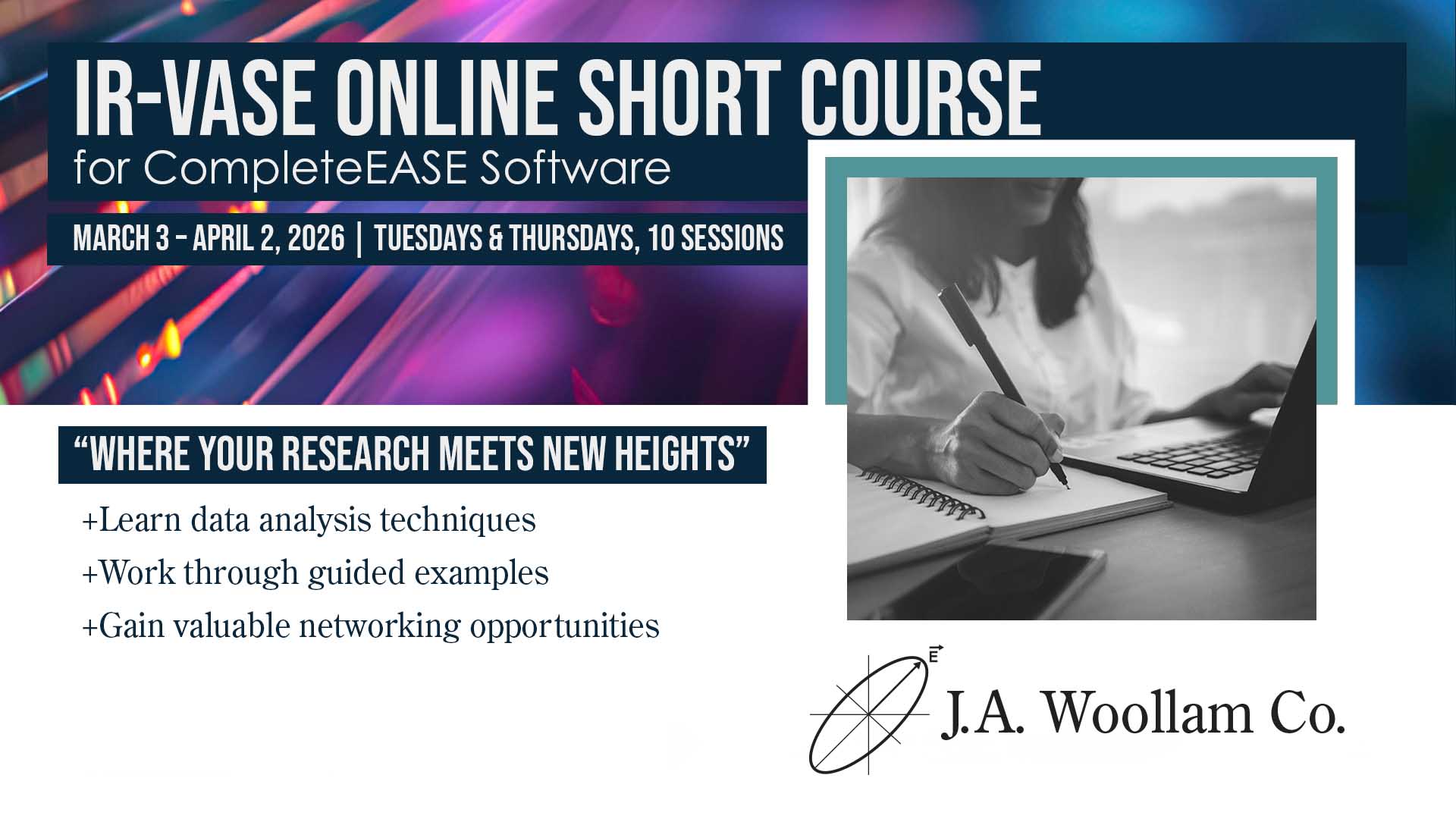
IR ellipsometry data acquisition and analysis requires unique skills that are different than UV/visible wavelength ellipsometry. We are offering this on-demand course to help our IR-VASE® customers develop these skills using the CompleteEASE® software for data analysis. The course will consist of 10 sessions. The last two sessions are optional.
- Each registered participant will receive video links for all sessions, several how-to videos, references, as well as data files for examples and homework for each session.
- Completed homework can be emailed to homework@jawoollam.com as a CompleteEASE Snapshot file, to be review by instructors. Registered participants who submit >70% of the homework from sessions 3 through 8 will receive a certificate of participation.
- Sessions 9 and 10 are optional, since not every participant may be interested in modeling phonons and anisotropy.
- Woollam Instructors will be available to answer questions via email and live interactions (via MS Teams or Zoom).
Register below. For more information please contact Tom Tiwald at ttiwald@jawoollam.com.
Session 1: Introduction to Infrared Ellipsometry
- Light & Polarization
- Instrumentation
- Light & materials
- Interfaces & films
- Intro to Modeling & Analysis
- Intro to CompleteEASE Software
Session 2: Sample Preparation + Data Acquisition
- IR-VASE Scan dialog box
- Choosing acquisition parameters
- Backside reflections & Backside roughening
- Beam size & masking
Session 3: Transparent substrates and films
- Introduction to the Genosc layer for transparent materials
- Fitting Transparent Substrates
- Fitting Transparent Films: Interpreting Ψ oscillations, index contrast & thickness
- Surface Roughness & Grading
Session 4: Absorbing substrates and films
- Introduction to the IR B-Spline layer
- B-Spline IR modeling of absorbing substrates
- Glasses, amorphous & Crystalline materials
- B-Spline IR modeling of absorbing films
Session 5: Modeling absorption with Genosc layer
- Using Genosc oscillators to model absorption
- Lorentz & Gaussian oscillators
- Using Genosc layers from the IR Library
- Converting from B-Spline to Genosc
Session 6: Free Carrier Effects (doping)
- The Drude model & fitting doped substrates
- Sensitivity to free carriers at IR wavelengths
- Fitting Doped substrates & layers
Session 7: Non-ideal samples and measurements
- Effects of non-idealities on Ψ & Δ
- %Depolarization
- Modeling non-idealities
Session 8: Advanced Topics I – Multisample + Multi-dataset analysis
- Multisample (Multi-dataset) Analysis
- Analysis of combined IR-VASE & UV-visible-NIR data
- Analysis of combined ellipsometric & transmission data
Session 9: Advanced Topics II – phonons, TOLO and anharmonic oscillators
- Anharmonic vs. Harmonic oscillator functions
- The Dielectric (epsilon) & Loss (-1/epsilon) functions
- Product (TOLO) & the Sum (anharmonic Lorentz) forms of the dielectric function
- Fitting infrared phonon with the TOLO and anharmonic Lorentz oscillators
Session 10: Introduction to Anisotropy
- Description
- Measurement
- Building Anisotropic models