Ultra-Thin Films
The short wavelength capability of the VUV-VASE is beneficial when measuring very thin nm-scale films. At VUV wavelengths, there is higher sensitivity to the thickness and refractive index, which is not available at visible and near infrared wavelengths.
The measured Delta data shown are from a 4 nm thick high-index dielectric film on silicon. The model using transparent SiO2 with lower index does not match the data at higher photon energies, whereas the HfO2 model does match data at all wavelengths. This demonstrates that there is sensitivity to both the higher index of refraction and the absorption at VUV wavelengths.
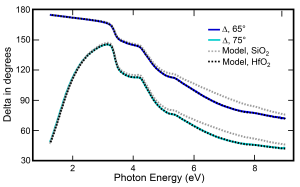
Ellipsometric delta data collected from a very thin (4 nm) hafnium oxide thin film. Data in the VUV helps determine the correct refractive index.
High-Bandgap Materials
The VUV-VASE measures a very wide photon energy range from 0.5 to 8.5 eV. This allows study of the electronic transitions in all types of semiconducting and dielectric films. The high energy electronic transitions of group-III nitrides affect the VUV dielectric functions as shown.
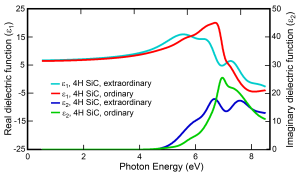
The VUV-VASE is useful for studying the band structure of semiconductors at high photon energies. Shown are the dielectric function of GaN and AlN measured to 8.5 eV.
Deep UV Optical Coatings
Optical elements used in the VUV can be enhanced using optical coatings. Coating performance depends on refractive index and thickness. Fluorinated materials remain transparent into the VUV, and the index for various fluorides measured with the VUV-VASE is shown. In addition, the VUV-VASE can measure transmitted intensity to characterize low-level absorption at VUV wavelengths. The VUV-VASE is also used to study coating damage from irradiation, which can induce surface damage and bulk damage.
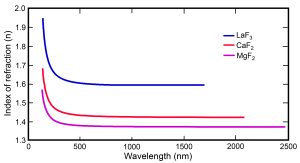
Index for fluoride materials measured with the VUV-VASE
Lithography: Polymer Photoresist Film Optical Constants
Lithography thin films were an important motivation for the VUV-VASE development. Polymers and photoresist films are still important at short wavelengths. The VUVVASE provides excellent characterization capabilities at 193 nm (6.42 eV) for current lithography applications because data can be collected surrounding this wavelength to ensure correct modeling for most accurate n and k values.
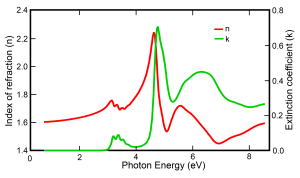
Optical constants measured for an organic photoresist
Liquid Optical Properties
The VUV-VASE can be enhanced with a hollowprism cell and special measurement algorithm to determine the optical properties of a liquid. This is achieved via the minimum deviation method. Results are shown for a series of UV-transmitting liquids.
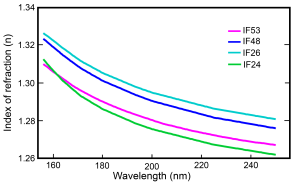
Index for various immersion fluids measured with the prism minimum deviation method on a VUV-VASE